Skip to content
A service by Laboratorio Aclimu
Atlas
Genómico

Your genome, read by a laboratory — not an app

A genomic test that says what it knows, what it does not know, and how much evidence stands behind each thing it states.

654,027
positions read
probes in the array manifest (GSA-24 v3)
1,283
conditions checked
predispositions and carrier status, each with its coverage
38
polygenic scores
adjusted for your ancestry
30
days
from sample collection to the report
What it includes

Eight sections of results, a single test

Each one carries its grade of evidence in the corner. You can open any of them and see exactly how it is presented in the sample report.

What sets us apart

Not every finding is worth the same

Communicating genetic risk, on its own, does not change anyone's behaviour — a systematic review using Cochrane methods shows as much. The value of a test like this lies not in reporting risks but in the concrete clinical decisions it enables. That is why every finding carries its level stated.

Hollands et al., BMJ 2016;352:i1102 — systematic review with meta-analysis.

  1. A

    Established clinical use

    There is a professional guideline stating what to do. It can change clinical management.

  2. B

    Solid support

    The association is firm, but what it adds to what clinical assessment already tells us is limited.

  3. C

    No demonstrated change in management

    Replicated across several studies, with no evidence that knowing it improves an outcome.

  4. D

    Exploratory

    Traits with no clinical implication. They are included out of interest, not usefulness.

Every finding states its evidence

The report opens showing only what can change clinical management. The rest is there, but behind a switch. A genetic test that presents bitter-taste perception with the same weight as a clopidogrel interaction is not being honest with whoever reads it.
We say what we cannot measure

RYR1, CYP2D6, Atrofia muscular espinal, Síndrome de X frágil, Mucopolisacaridosis tipo II (Hunter), Alfa-talasemia: the platform does not resolve them, and they appear anyway with the reason. A report that leaves out what it did not measure reads as if it had ruled it out.

A laboratory interprets it

There is a kit, but the analysis is not outsourced: the same laboratory processes and interprets it, and it also holds your testing history. The report stays in your account permanently.

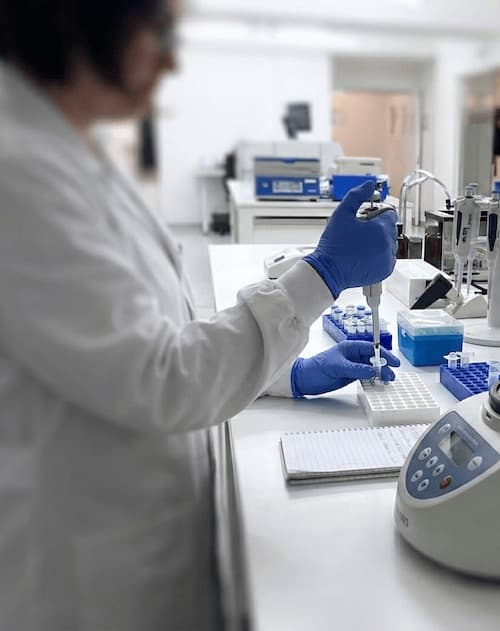
Genetics bench at Laboratorio Aclimu
Where it is done

The same laboratory, from sample to report

Sample collection, processing, quality control and interpretation are all done by the same laboratory, in Recoleta, Buenos Aires. None of the four is outsourced.

654,027
positions read
1,422
results in your report
30
days until the report

Atlas is the personal genomic test from Laboratorio Aclimu (Buenos Aires, Argentina, since 1991): microarray genotyping on Illumina Infinium Global Screening Array v3 (GSA-24 v3.0), interpreted by the laboratory itself. ARS 159,000, results in 30 days.

How to buy it

Five steps, and the only in-person one takes five minutes

  1. 01

    You book

    You confirm your email with a code, leave your details and choose how many kits. Nothing is paid yet.

  2. 02

    You pay online

    With Mercado Pago, right then. As soon as it clears, the code for each kit arrives by email.

  3. 03

    You register your kit

    Each person registers theirs in their own account: that is what ties the sample to a name. If you were given a kit and have no account, you open one with the code at /kit.

  4. 04

    You give the sample

    Saliva or a cheek swab. At our premises it takes five minutes, or you take the kit with you and bring the tube back whenever you can.

  5. 05

    You get the report

    After 30 days it is published in your account, with the level of evidence for every finding. It does not expire, and it is reinterpreted as the evidence advances.

About 30 days pass between the sample and the report, and the report stays in your account permanently.

Your genome does not change. The reading does.

Genotyping is done once: your data is already read. What changes is the interpretation — every year new variants are described and others are reclassified — so your report is reinterpreted with whatever is known by then, without repeating the sample. If anything of yours changes, we let you know.

Book the testARS 159,000